
01 / PROJECT OVERVIEW
The business challenge
Integrating an ERP with an external fiscal interface involves more than sending invoice data. Tenant identity, branch and device context, credentials, request contracts, duplicate submissions, uncertain network outcomes, and traceable evidence must all be controlled. The adaptor concentrates these responsibilities in a separate integration layer while preventing incomplete or unqualified transactions from being presented as accepted fiscal documents.
How the system is organised
A registry and authentication foundation establishes tenant, taxpayer, branch, device, and credential context. Reviewed sandbox operations pass through validated mappings and transport contracts, while call evidence is persisted before dispatch. Uncertain outcomes quarantine the relevant device or context rather than automatically replaying a potentially consequential request. Separate mock workspaces exercise integration flows without opening production fiscal routes.
Who it is for
Cybersoft integration operators, ERP/POS software teams, and organisations evaluating controlled electronic-invoicing integration. Impact360ERP has a documented mock bridge; Medisphere and other business systems remain integration targets rather than universally live connectors.
A gateway foundation, not a certified fiscal service
The implemented scope covers multi-tenant identity, registries, scoped access, audit metadata, environment separation, and reviewed sandbox contracts. It is intentionally described as a foundation and testing build. Canonical production tax, invoice, and receipt processing, final sandbox qualification, and actual approval remain outside the current completed scope.
Keep uncertain outcomes visible
The sandbox implementation maintains encrypted call state and separates request preparation, dispatch, response handling, and recovery. Device serialisation, idempotency, and quarantine controls address the risk of sending duplicates or continuing after an ambiguous result. Recovery is an explicit operator workflow, not an automatic claim that an upstream transaction failed or succeeded.
Rehearse the ERP journey without fiscalising records
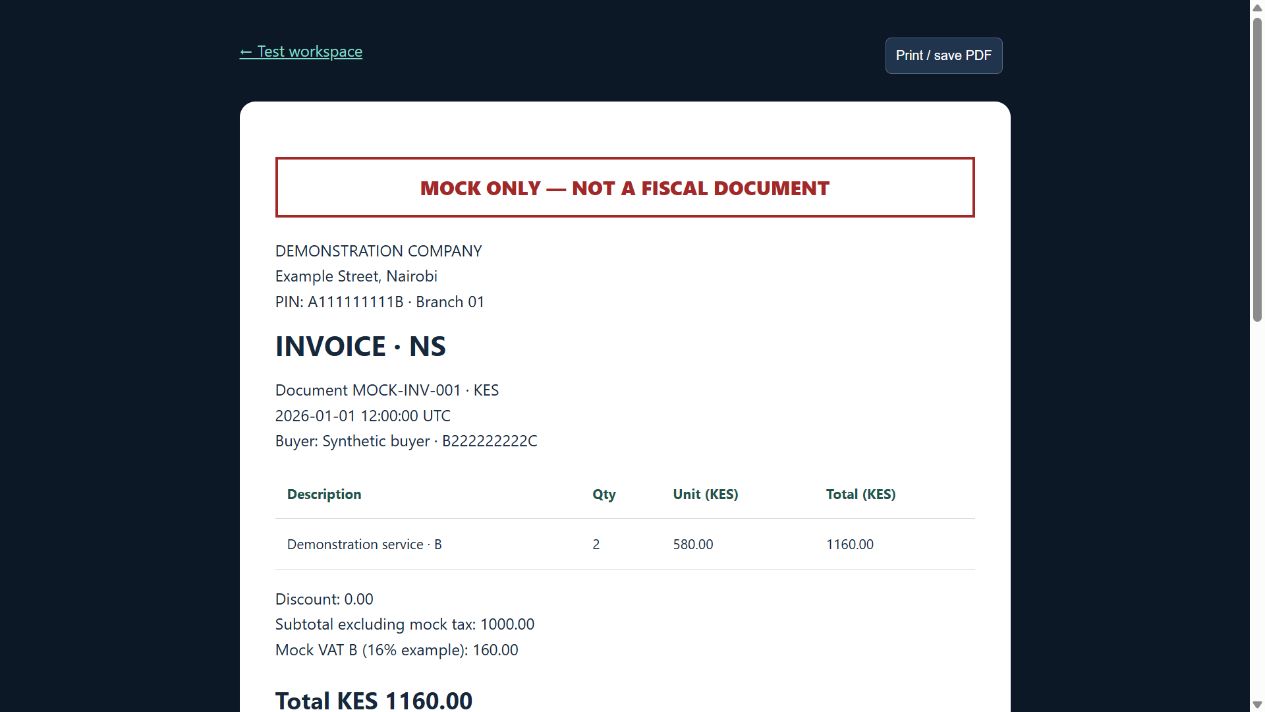
The local workspace includes synthetic invoice and credit-note layouts and a customer/item/invoice/credit-note queue demonstration. The Impact360ERP bridge uses narrow credentials, encrypted snapshots, mapping checks, and duplicate protection. These are real software test surfaces, but their displayed results are mock evidence and do not demonstrate KRA acceptance.
02 / MODULES & WORKBENCHES
Designed around the workflow.
Tenant & connection registry
Provision and manage tenant lifecycle, scoped application credentials, and taxpayer, branch, and device registries. Authentication keys are scoped to the relevant integration context; public self-signup is not part of the implemented gateway foundation.
Sandbox OSCU adapter
Provide reviewed sandbox transport, validated request/response contracts, device initialisation, local recovery, lookup families, and supported sandbox write shapes. Networking defaults to disabled and must be explicitly enabled for an approved sandbox device.
GavaConnect testing connector
Support sandbox OAuth authentication, reviewed testing-path mappings, generated-session context, and an encrypted operator journal. Registration and authentication evidence are distinct from a completed certification test cycle or successful live fiscal submission.
Call journal & quarantine
Persist call evidence before dispatch, retain outcomes, and isolate uncertain or ambiguous device states. Idempotency and device serialisation reduce duplicate-processing risks while preserving the evidence needed for an authorised recovery review.
Offline contract workspace
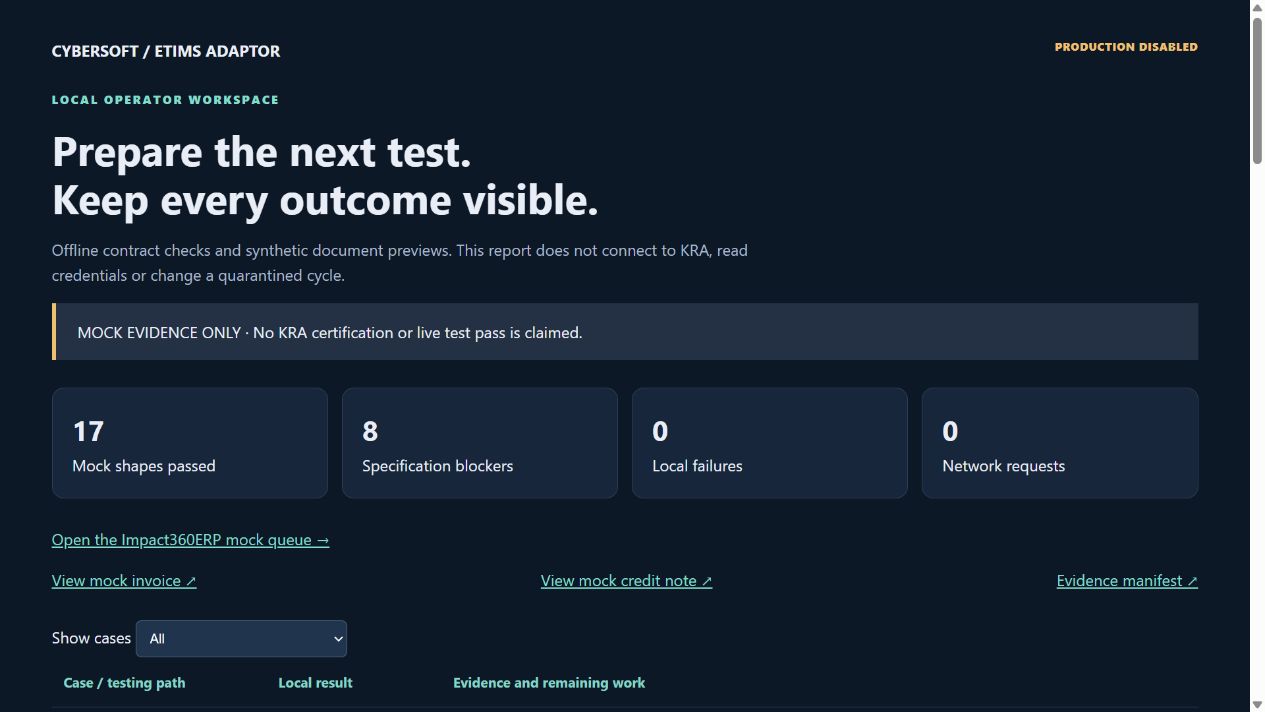
Display local contract-shape results, specification blockers, and mock invoice/credit-note previews. The workspace uses synthetic identities and mock evidence, makes no network calls, and keeps production-disabled labels visible.
Impact360ERP mock bridge
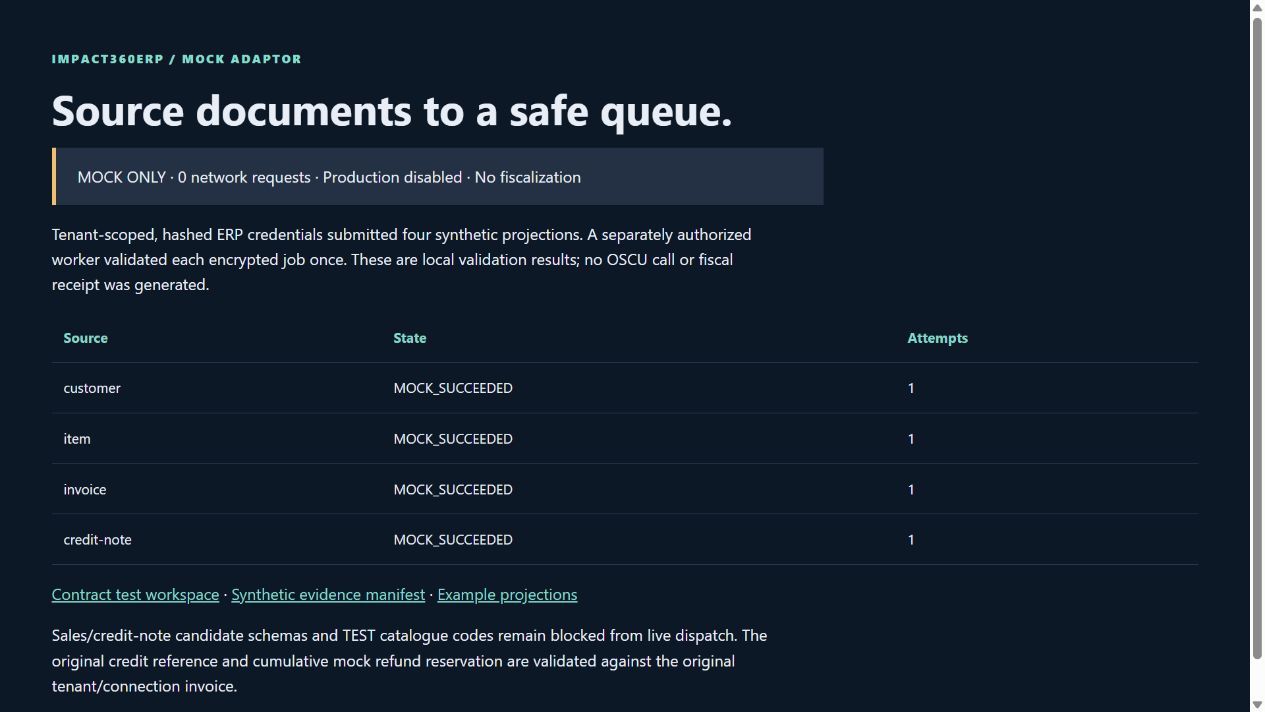
Project customer, item, invoice, and credit-note records through a separate mock integration contract. Tenant-scoped credentials, encrypted durable jobs, narrow exporter access, and a local worker support an end-to-end rehearsal without a live fiscal dispatcher.
Mapping & source-data readiness
Validate expected source mappings and frozen document information before mock processing. Records with missing fiscal classifications, unresolved product links, or incomplete invoice-line evidence are held for review rather than filled with invented values.
API contracts & operator tools
Provide OpenAPI/Postman contracts for the implemented foundation plus CLI health, status, deployment, and mock-workflow tools. The repository explicitly identifies the authenticated operations portal, SDK/webhooks, and production fiscal engine as remaining work.
03 / FEATURES & BENEFITS
Documented capabilities
- Tenant provisioning and lifecycle controls
- Scoped application credentials and isolated registries
- Environment separation and encrypted device/call state
- Sandbox request and response validation
- Persist-before-dispatch call evidence
- Device serialisation, idempotency, and uncertain-outcome quarantine
- Reviewed GavaConnect testing mappings and sandbox OAuth handling
- Network-free contract rehearsal and watermarked document previews
- Impact360ERP customer, item, invoice, and credit-note mock projections
- Encrypted mock jobs, local worker, and duplicate protection
- Mapping/source-readiness checks that hold incomplete records
- API documentation, Postman contracts, health checks, and operator commands
Operational value
- Separate integration controls from the ERP’s day-to-day business screens.
- Make request outcomes and unresolved contract issues visible to operators.
- Rehearse ERP document flows without submitting production fiscal records.
- Reduce accidental duplicate processing through scoped identities and idempotency controls.
- Preserve a clear distinction between mock success, sandbox evidence, and production approval.
04 / EXAMPLE WORKFLOW
From first step to follow-through.
- Provision the integration tenant, scoped credentials, and approved registry context.
- Map source records and validate their required identity, product, and document information.
- Exercise the selected reviewed sandbox contract or isolated mock queue, preserving call/job evidence.
- Review the recorded outcome and any mapping or quarantine gate; keep unqualified production operations disabled.
05 / DELIVERY & TECHNOLOGY
Implementation scope
- Standalone gateway foundation and scoped registries
- Sandbox OSCU and GavaConnect testing components
- Encrypted call journal and recovery/quarantine controls
- Offline operator workspace and mock document previews
- Impact360ERP mock exporter, queue, and validation tools
- Implementation-status, API, contract, and deployment documentation
Technical details
The project requires PHP 8.3+ and CodeIgniter 4.7. Documentation targets MySQL/PostgreSQL for deployment, while SQLite is used for isolated local tests. Production database concurrency and full production fiscal capability are not claimed as verified.
PHP 8.3+CodeIgniter 4.7OpenAPI / PostmanSodium encryptionSQLite for isolated tests06 / INSIDE THE APPLICATION
Module screenshots
These are screenshots of the actual local sandbox/mock software, not live production module screens.
Sandbox contract workspace
Impact360ERP mock queue
Watermarked invoice layout
SCOPE & AVAILABILITY
What to know before a demonstration
Not a certified fiscal integration. Production submissions, canonical fiscal receipt generation, unresolved sales/credit-note contracts, and other documented gates remain unavailable. Screenshots below are captured from the actual local mock workspace and are explicitly labelled as such.
Profile reviewed against the adaptor README, implementation-status document, offline workspace guide, Impact360ERP mock-integration documentation, and Codex verification updates. Screenshots show source-generated local test reports, not a live KRA-certified portal.